More comments from NAPA listening session

The comments continue regarding research, public awareness, health care, long term care and more!

“The caregiver needs help because they often resist support and don’t reach out for help until they are half dead. One of the things that is important is to be more proactive in reaching the caregiver earlier and getting resources into their hands as soon as possible.”

“We need more support groups and funding for people with the disease which can teach them coping strategies and emotional support.”

“I’ve worked with people with Alzheimer’s for more than 35 years. I have two grandmother’s who passed away, my father passed away. The hardest workers are those that work with Alzheimer’s patients. We don’t have the money to pay them what they are worth. The government needs to do something to help caregivers. We need training, resources and oversight.”

“I wanted to come to this event to be educated. I just wanted to thank all of you who have done all these wonderful things to help with this awful disease. I had no idea the intensity and depth of it. I congratulate and commend all of you.”

“I took my mother to a physician because she was walking in a strange way. I felt like something was very wrong. We spent about half an hour in the office. The doctor said ‘It doesn’t look like Parkinson’s’ and that ended the conversation. They gave me a bag of prescription meds and I discovered Aricept in the bag. There had been no mention of Alzheimer’s at the appointment. I called the doctor to ask if my mother had Alzheimer’s and didn’t get a call back. I had to call again before her doctor told me that she did indeed get a diagnosis.”

“I was diagnosed at a facility in San Francisco. I went through the 6 hours of testing and when I finally got the results they said you either have ADD or you have Alzheimer’s. After being in a little bit of denial, I called my doctor and asked for Aricpet and he asked ‘Why? you don’t have anything that indicates you have memory loss!’ I had to advocate for myself and connect the two doctors.”

“My father was diagnosed with Alzheimer’s 2.5 years ago. It’s been a really tumultuous and difficult road.Tthere are 3 daughters and we have a very difficult road figuring out the best care for my father. We are in this hole where we don’t qualify for Medical but we have too much money to pay for the type of care needed. It’s a 24 hour job and it’s expensive. What money is going to be left for my mother when she gets sick? This health care quandry is a big dilemma. We have to muddle through but we don’t know how long we can.”

I lost my father 3 weeks ago at the age of 64. The staff at facilities did not know how to handle him when he got angry so he got bounced around. We need more money and education for our caregivers so they understand the 7 stages and how to deal with behavioral problems.”

“My husband is 70 years old and was diagnosed at 64. I have found daycare for him and I have one caregiver. My problem with the day care system is with very old people who are content to do sitting games and he needs something more active. I’d like to see day care programs that are a little more physical. I took a savvy caregiver class at the Alzheimer’s Association and it changed my life. It needs to be shared with more people.”

“How can people with disabilities, with HIV/AIDS have protections and people with Alzheimer’s don’t?”


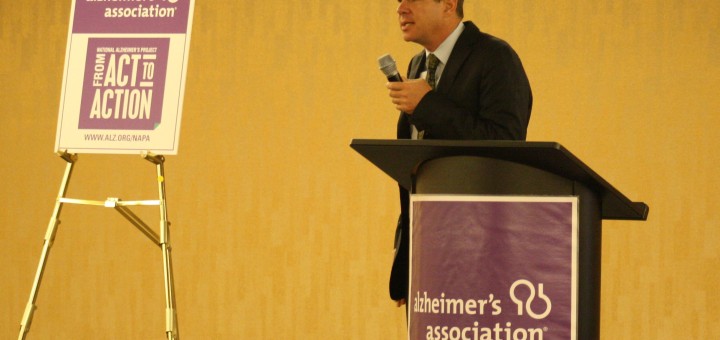
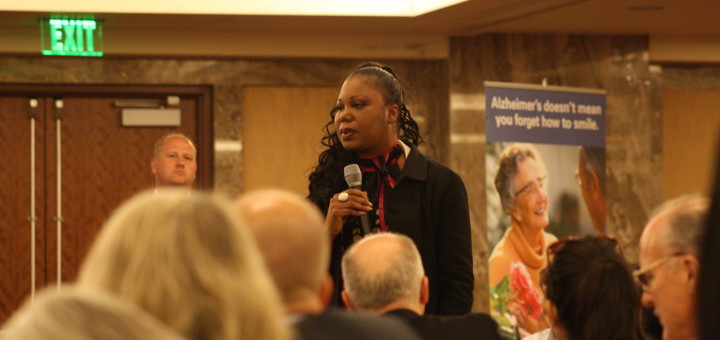
NAPA listening session is underway in SF!

Don Moulds, health and human services

The National Alzheimer’s Project Act listening session is underway in San Francisco. More than 200 Alzheimer’s advocates are currently at the San Francisco Union Square Hilton telling Don Moulds, deputy assistant secretary for Planning and Evaluation for Health and Human Services what they think needs to be included in a national plan on Alzheimer’s disease. Some comments so far:

“If we don’t know what the problem is we can’t fix it. Who will fix it? We need to create communities in which Alzheimer’s is recognized and acknowledged.”

“We have a tremendous opportunity to move forward and if we don’t put resources towards this disease we will miss that opportunity. There is an army of passionate excited young people who want to devote their careers to Alzheimer’s; if they dont’ get the support and resources they need, we’re going to lose a lot of time and a lot of young scientists”

“The funding for HIV/AIDS is much higher than that for Alzheimer’s I would challenge the government to fund Alzheimer’s as well as HIV. I feel that large incremental increase can help us go a long way so we can find a cure for this disease. It won’t be soon enought for me but it will protect my daughter.”

“We started as control subjects in a UCSF study; little did we expect one of us would be diagnosed. It’s a surprise after working hard your whole life to have this happen. It’s hard to do this.”

“I find it very upsetting that so few people know what Alzheimer’s truly is and what it truly does to someone. I can’t tell you how many times I’ve told people about my grandmother’s Alzheimer’s and they think it’s just memory problems. I think it would be important to have something that can bring awareness to the whole county and why it needs to be a national priority.”

“There needs to be education of first responders — police, fire fighters, emergency responders and how to recognize when someone has the disease.”

“I looked after my mom for 8 years while she was battling Alzheimer’s and I’d like to second what the previous speakers have said about the extreme ignorance of people about Alzheimer’s, even in the health care community. My in all the facilities my mother was in, I found that most nursing staff, even doctors and CNA’s lack an understanding of how to care for Alzheimer’s patients.”

“Incarceration is not the answer for demented people. I had an officer tell me they would rather deal with a criminal than a person with dementia.”

Copyright © 2013 Alzheimer's Association. All Rights Reserved.

Through this website you are able to link to other websites which are not under the control of the Alzheimer’s Association. We have no control over the nature, content and availability of those sites. The inclusion of any links does not necessarily imply a recommendation or endorse the views expressed within them.

Chapter Headquarters
Alzheimer's Association of Northern California and Northern Nevada
1060 La Avenida, Mountain View, CA 94043 Phone 650.962.8111

National Headquarters
Alzheimer's Association National Office 225 N. Michigan Ave., Fl. 17, Chicago, IL 60601 Alzheimers and Dementia Blog – Alzheimers Association of Northern California and Northern Nevada

Built on Notes Blog Core
Powered by WordPress